
New Haven notes
Updated 4 sources
Keys left behind by past households
About 15 percent of Connecticut's housing units sit in buildings with two to four units. In New Haven's Winchester Repeating Arms Company Historic District, shared by Newhallville and Dixwell, the streets filled with one-, two- and three-family worker housing after the plant moved there in 1870. Developers Joseph Sheldon and John W. Bishop drove the building of nearly every house on Admiral Street and most of Henry Street. Each move-out in a house like that can leave copies of a unit key, a front-door key and a back-door key in circulation.
Rekeying changes the pin stack inside a cylinder so the old keys stop turning it. The lock body, trim and door stay put. Rekeying a shared entry means cutting a new key for every household that uses it.
City and state rules that touch keys
This is general information, not legal advice.
- Rental licenses. Chapter 17, Article XIV of the New Haven Code of Ordinances requires owners of rental buildings with two or more dwelling units to hold a residential rental license, administered by the Livable City Initiative. Section 17-74, as amended in 2025, exempts owner-occupied buildings with two or fewer rental units, among others.
- Inspections. Section 17-75 calls for a housing code inspection before a license is issued, and under Section 17-78 a tenant must consent before their unit is inspected.
- Key deposits. Conn. Gen. Stat. § 47a-4d bars most up-front charges but allows a deposit for a key or special equipment.
- Move-in walk-through. For rental agreements made on or after January 1, 2024, § 47a-7c requires the landlord to offer a walk-through on the Department of Housing checklist, which can record a missing key.
When New Haven owners and landlords rekey
- After closing on a house, since the seller's relatives, contractors and past tenants may still hold keys.
- Between tenants, for the unit door and every shared door the last household could open.
- When a postwar house still has its first locks. Roughly four in ten Connecticut homes date from 1950 to 1979, and keys to original hardware may have been copied many times.
If the cylinder itself is worn or damaged, lock replacement may be the better fit. More on lock rekeying and New Haven.
At the door
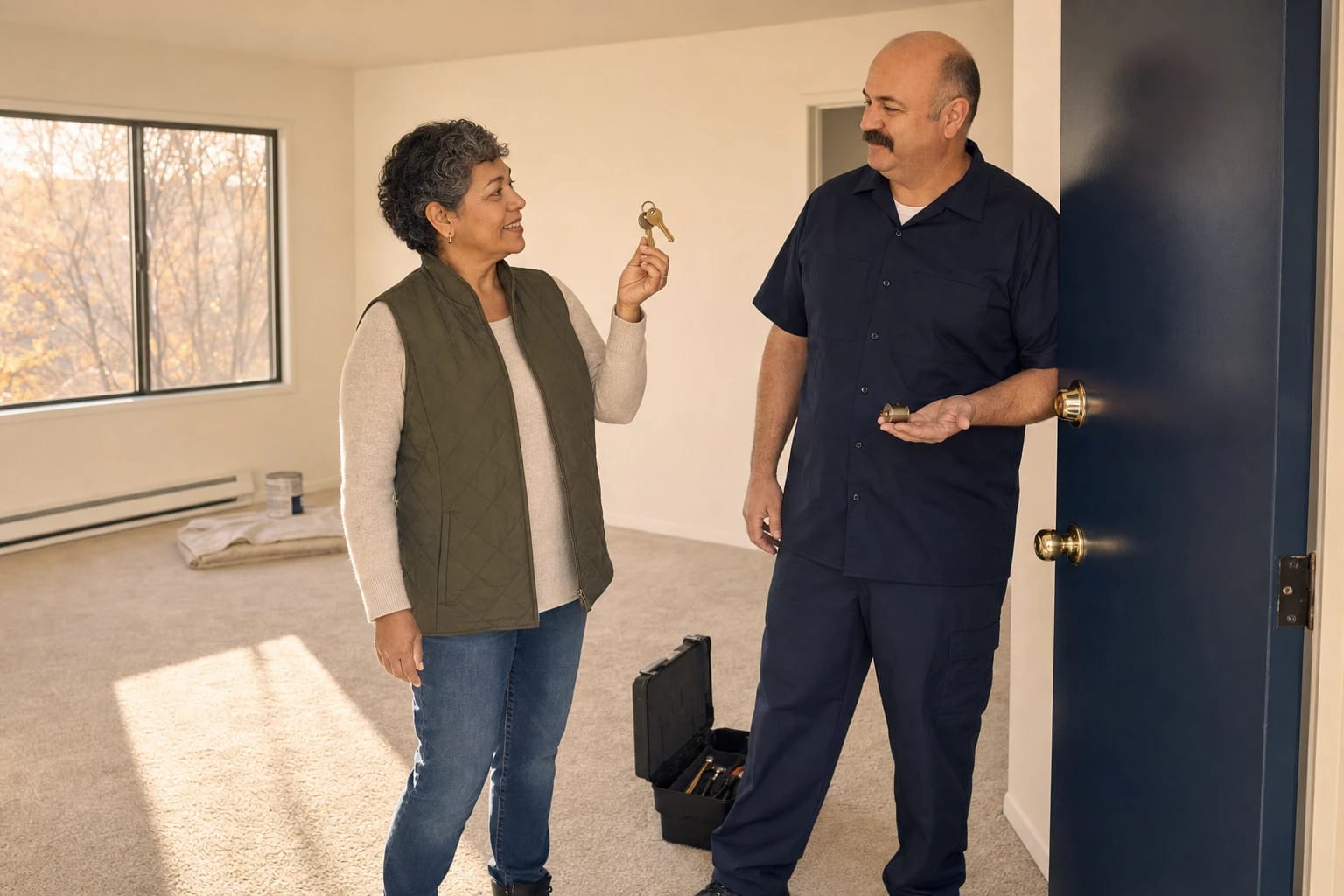
What lock rekeying covers
Changing the pins inside your existing locks so old keys stop working, without replacing the hardware.
- An inspection of each lock to confirm it can be rekeyed
- Re-pinning each cylinder to work with a new key
- New keys cut for the rekeyed locks
ID and proof you may access the property are checked before any work.
Lock Rekeying in ConnecticutSources
Public records and references this page draws on. They are outside USA Locksmith Pros and open in a new tab.
- Winchester Repeating Arms Company Historic Districten.wikipedia.org (external site, opens in a new tab)
- New Haven Code of Ordinances, Ch. 17, Art. XIV, Residential Rental Business Licenses (Municode)library.municode.com (external site, opens in a new tab)
- U.S. Census Bureau ACS 2024 1-year, tables B25024 and B25034 (via Census Reporter)api.censusreporter.org (external site, opens in a new tab)
- Connecticut General Statutes, chapter 830 (landlord and tenant)cga.ct.gov (external site, opens in a new tab)