
Hartford notes
Updated 3 sources
How Hartford winters wear on locks
NOAA's state climate summary puts Connecticut's average January temperature at 27.2°F, below 32°F. Snow that melts on a sunny afternoon can run into an exterior cylinder and turn back to ice overnight. Ice stops the pins from lifting, and a key forced against it can bend or snap.
Oil is the wrong fix, since it thickens in the cold and collects grit, so the lock stiffens each winter. A dry lubricant such as graphite or a PTFE product suits exterior locks. Pouring hot water on a frozen lock only adds more water to turn to ice again.
Older houses, older hardware
In an older house, a lock problem is often a door problem. Upper Albany's two-family frame houses and the West End's homes date largely from the 1900s through the 1920s, and South Green has houses from the 19th century. Wood doors and frames move between damp and dry seasons, so a latch that caught cleanly in October may miss the strike plate in January. A deadbolt you have to push or lift to turn is often an alignment problem, and adjusting the strike plate or tightening hinge screws can fix it without new hardware.
Postwar houses wear in their own way. Roughly four in ten Connecticut homes date from 1950 to 1979, and in Southwest's 1940s-to-1960s houses, original knobs may have worn pins and loose spindles.
Simple upkeep before the cold
- In fall, puff dry lubricant into each exterior cylinder and work the key several times.
- Tighten loose hinge, strike and trim screws.
- Check that the deadbolt slides fully into the frame without pressure on the door.
- After a storm, brush snow and ice off exterior locks rather than chipping at them.
What to include in a repair request
Say which door and what it does: the key will not go in, turns but the latch stays out, or the bolt drags. Mention whether it started with the cold, add a photo of the lock and the door edge, and say whether the door is your own or a shared entrance in a two-family or apartment house.
See lock repair, broken key extraction if a key has already snapped, or the Hartford page.
At the door
What lock repair covers
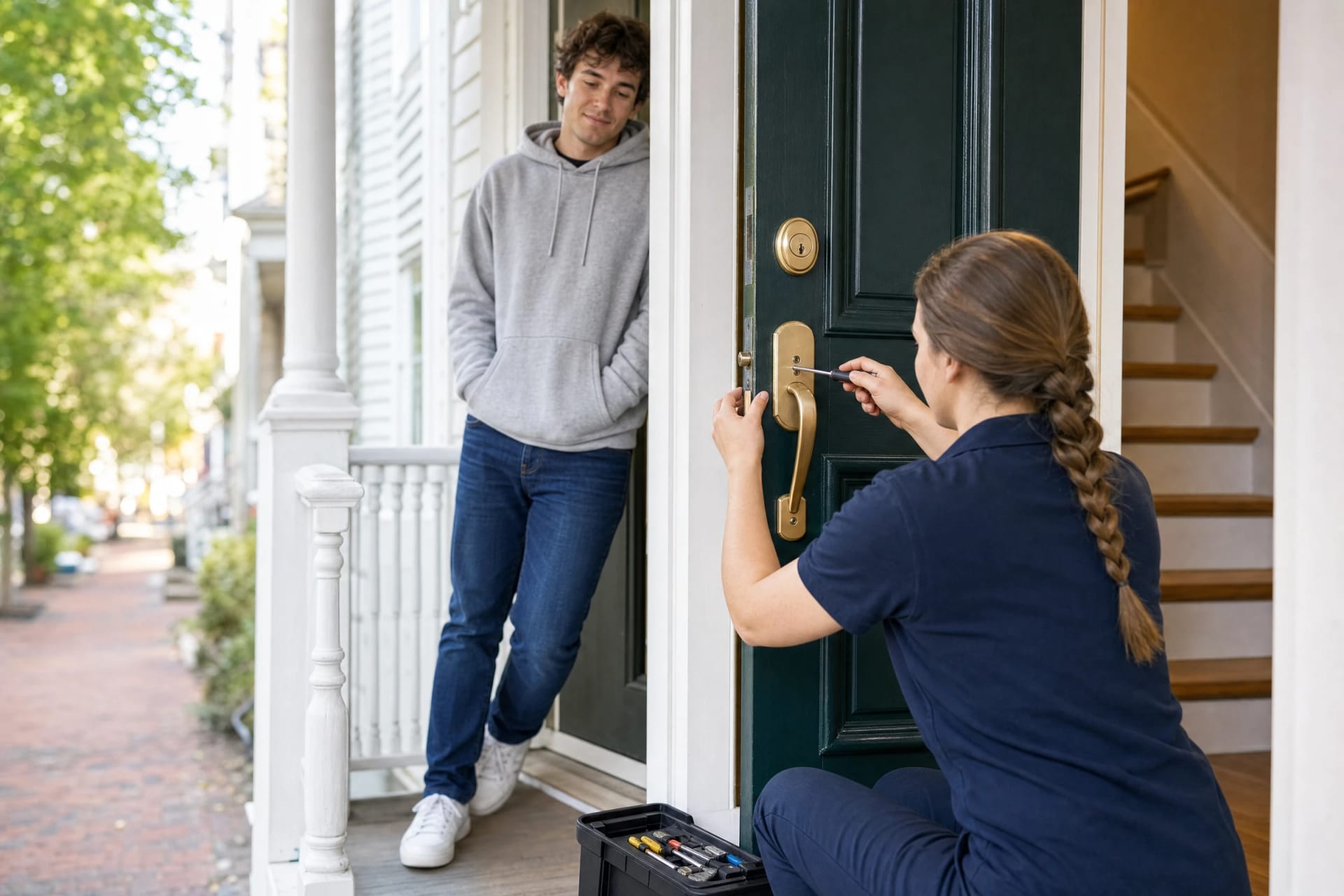
Diagnosing and fixing locks that stick, turn stiffly, will not latch, or have loose or misaligned parts.
- Diagnosing why the lock is sticking, binding, or failing to latch
- Cleaning and lubricating the lock mechanism where appropriate
- Adjusting or realigning the strike plate and latch
ID and proof you may access the property are checked before any work.
Lock Repair in ConnecticutSources
Public records and references this page draws on. They are outside USA Locksmith Pros and open in a new tab.
- NOAA NCEI and NCICS, State Climate Summaries 2022: Connecticutstatesummaries.ncics.org (external site, opens in a new tab)
- Neighborhoods of Hartford, Connecticut (Wikipedia)en.wikipedia.org (external site, opens in a new tab)
- U.S. Census Bureau ACS 2024 1-year, tables B25024 and B25034 (via Census Reporter)api.censusreporter.org (external site, opens in a new tab)