
Columbia notes
Updated 3 sources
Rain and heat on Columbia locks
Heavy rain is the harder test. On October 4, 2015, a Columbia gauge logged 17.7 inches of rain, breaking the state's previous 24-hour record of 14.8 inches. Water that reaches a lock carries grit into the pins and starts corrosion on springs and screws. A lock that sat in floodwater, or on a door that took wind-driven rain for hours, should be checked for corrosion and cleaned even if the key still turns.
Heat is the slower wear. From 1991 to 2020, Columbia averaged 3.5 days a year at 100°F or hotter, NOAA's state climate summary notes. Wood doors and frames move with heat and moisture, so a deadbolt that throws cleanly in January can bind against its strike by August, and grease inside a cylinder thins, then collects dust and turns gummy.
Mill-village and conservation-district doors
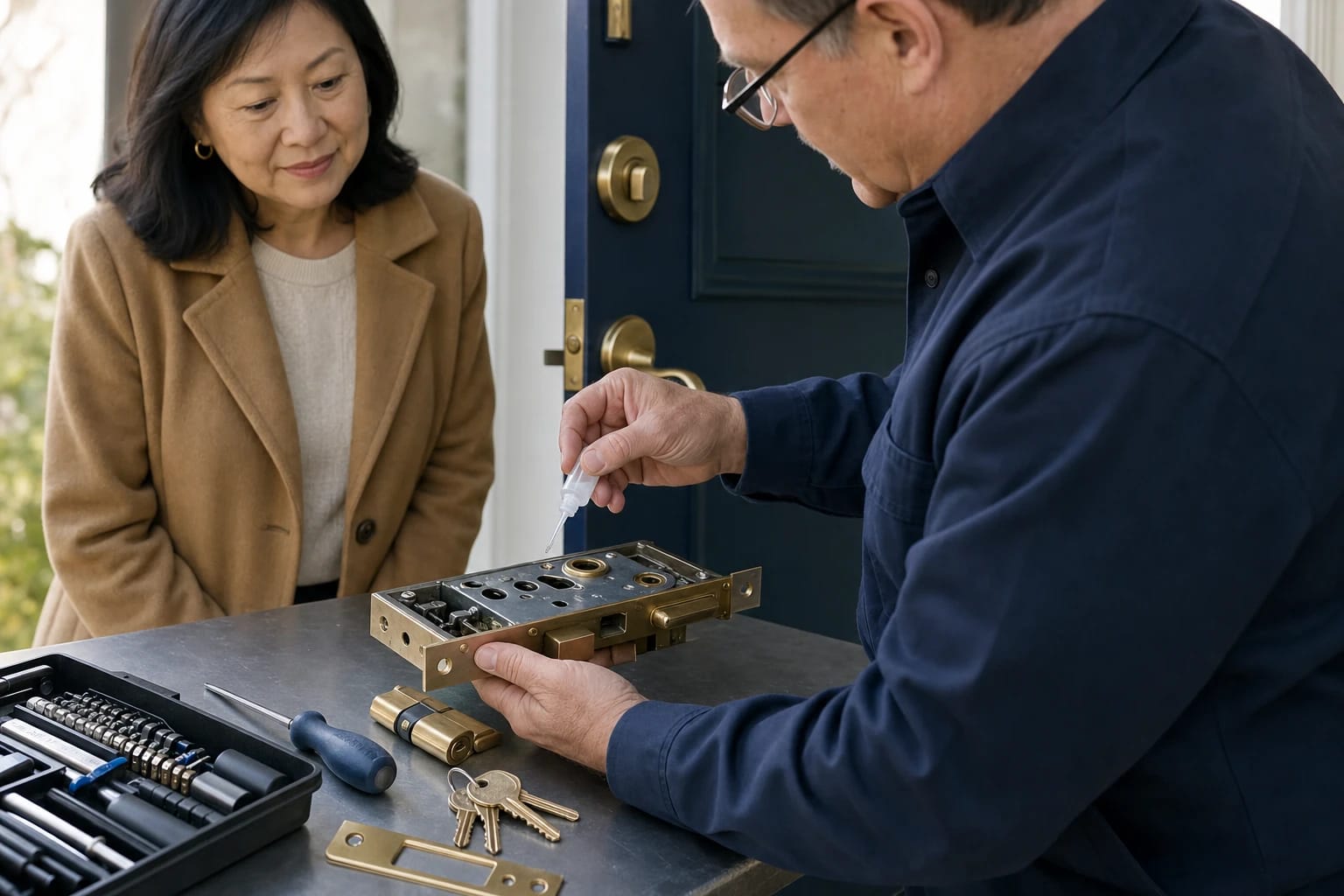
Whaley Street's district, where most buildings date from the 1910s and 1920s, is one of two that preserve mill villages; Granby is the other. Wales Garden and Melrose Heights/Oak Lawn are among the architectural conservation districts, where exterior work generally goes through city review. Repair keeps an original lock working on its original door without changing what shows from the street. Typical fixes include moving or filing a strike plate, resetting a sagging hinge, replacing a broken spring, cam or tailpiece, and cleaning out a gummed cylinder. When parts for an old lock can no longer be found, lock replacement is the next step. This is general information, not legal advice.
Simple upkeep
- Treat cylinders with a dry, lock-specific lubricant such as graphite or PTFE; oily sprays attract dust.
- After a heavy storm, work each exterior lock a few times and look for rust at the faceplate.
- Never force a stiff key. One that snaps in the cylinder needs broken key extraction.
What to describe in a request
Say what the lock does wrong and when it started: after a storm, during a hot stretch, or gradually over months. Name the door (front, back, side, gate or storm) and the neighborhood or cross streets. A short video of the key turning helps. See lock repair for the basics and Columbia for local background.
At the door
What lock repair covers
Diagnosing and fixing locks that stick, turn stiffly, will not latch, or have loose or misaligned parts.
- Diagnosing why the lock is sticking, binding, or failing to latch
- Cleaning and lubricating the lock mechanism where appropriate
- Adjusting or realigning the strike plate and latch
ID and proof you may access the property are checked before any work.
Lock Repair in South CarolinaSources
Public records and references this page draws on. They are outside USA Locksmith Pros and open in a new tab.
- NOAA NCICS State Climate Summaries 2022, South Carolinastatesummaries.ncics.org (external site, opens in a new tab)
- City of Columbia Planning & Development, Historic Districtsplanninganddevelopment.columbiasc.gov (external site, opens in a new tab)
- City of Columbia Planning & Development, Preservation Districtsplanninganddevelopment.columbiasc.gov (external site, opens in a new tab)