
Phoenix notes
Updated 5 sources
Three kinds of business address
Commercial lock work depends on which part of Phoenix a business sits in and who controls its doors.
- Central Avenue towers. Wikipedia's account of the corridor says Phoenix Corporate Center opened in 1960 and, at 341 feet, became the tallest building in Arizona, and that nearly 60,000 people are employed within three miles of the stretch between Camelback and McDowell roads. In a multi-tenant tower the lobby normally belongs to the building and each suite door to a tenant, so say which one needs work.
- Warehouse District. South of the downtown core, period buildings have been top targets for adaptive reuse and are home to several technology and creative businesses, according to Wikipedia's article on the downtown. A converted building may combine its original street doors with newer suite entrances, so name the exact door.
- Desert Ridge. According to Wikipedia, this northeast Phoenix master-planned community covers 5,700 acres under a specific plan adopted in 1991. It includes a 1.2-million-square-foot retail, dining and entertainment center, a JW Marriott resort, Mayo Clinic Hospital and an American Express regional campus. On a campus or in a retail center, the property manager often decides which doors may be worked on, so start there.
Storefronts in historic overlay districts
Some business addresses sit inside historic preservation overlays. Heritage Square Block 14, one of the city's nonresidential historic districts, lies generally between Sixth and Seventh streets, from north of Washington Street to Monroe Street; it was listed in April 1989 and has a period of significance from 1895 to 1920. The city's Historic Preservation FAQ says nothing inside an HP or HP-L overlay may be altered or changed in exterior appearance without first being reviewed by the Historic Preservation Office, while routine maintenance is excluded. If a storefront or entry door is in an overlay, ask the office before replacing it.
Key control when people move on
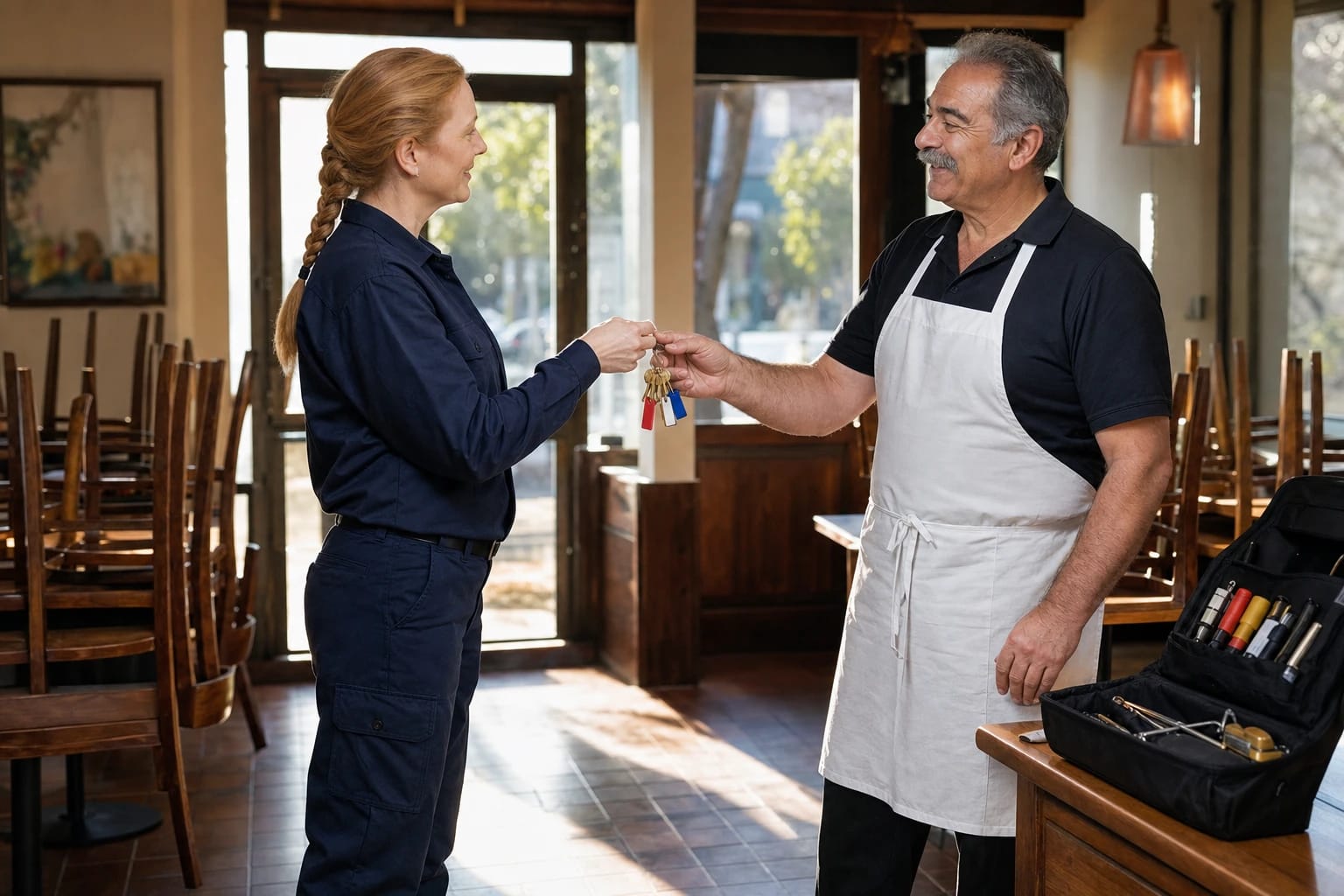
- Before rekeying after a departure, list every door that person's key opened; that list becomes the work order.
- In a leased suite, ask the landlord or building manager whether the building holds a key of its own before anything is changed, so the space does not end up closed to the people responsible for it.
- A business taking over a suite can retire every earlier key by rekeying the cylinders at move-in.
- Keep a written log of who holds which key, with dates.
Details to send
- the address or nearest cross streets, and whether the door is on Central Avenue, in the Warehouse District, on a campus or elsewhere
- the door type: aluminum-framed glass, steel service door or wood office door
- how many doors and cylinders are involved, and who holds keys now
- whether a landlord, manager or historic overlay approval applies
Downtown and the wider business picture are on the Phoenix page.
Business premises
What commercial locksmith covers
Lock and key work for offices, storefronts, and other business premises, from rekeying and repairs to hardware upgrades.
- Rekeying locks after staff or tenant changes
- Repair and replacement of commercial-grade locks and cylinders
- Lockout help for business premises
ID and proof you may access the property are checked before any work.
Commercial Locksmith in ArizonaSources
Public records and references this page draws on. They are outside USA Locksmith Pros and open in a new tab.
- Central Avenue, Phoenix, Arizona, Wikipediaen.wikipedia.org (external site, opens in a new tab)
- Downtown Phoenix, Wikipediaen.wikipedia.org (external site, opens in a new tab)
- Desert Ridge, Wikipediaen.wikipedia.org (external site, opens in a new tab)
- City of Phoenix, Historic Preservation Nonresidential Districtsphoenix.gov (external site, opens in a new tab)
- City of Phoenix, Historic Preservation FAQphoenix.gov (external site, opens in a new tab)