
Bridgeport notes
Updated 4 sources
Will your door take a smart lock
Smart lock installation starts with the door: most smart deadbolts are made for a modern door with a standard bored hole and bolt. Statewide, fewer than 6 percent of homes were built in 2010 or later and about one in five dates from 1939 or earlier, so a smart lock may have to suit a door that is decades older than the lock.
- Mortise doors. An original wood door with a mortise lock usually cannot take a standard smart deadbolt without new holes. Where a door has a separate deadbolt, a model that mounts on the inside and keeps the outside cylinder can avoid cutting the door.
- Warped or swollen doors. A motorized bolt stalls where a hand would push through. If the bolt drags against the strike, fix the alignment before installing.
- Thickness. Measure the door; some older doors are thicker or thinner than smart locks are sold for.
Approvals in shared buildings
- Cooperatives. Seaside Village, in Bridgeport's South End, has been a cooperative since 1955. In a co-op, check before changing any exterior lock.
- Rentals. A tenant normally needs the landlord's consent. Under Conn. Gen. Stat. § 47a-16, a tenant may not unreasonably refuse the landlord entry for inspections or repairs after reasonable notice, so settle in advance how the landlord will get in. Under § 47a-7b, a protected tenant's digital lock may get a new entry code instead of new hardware. This is general information, not legal advice.
- Shared entries. A smart lock on a door every household uses needs a code for each unit and a plan for removing codes when tenants move.
Cold, outages and backup keys
Connecticut's average January temperature is 27.2°F, and cold cuts battery output, so a lock that runs for months in fall may warn of low batteries after a cold snap. In the 2011 Halloween nor'easter, more than 700,000 Connecticut residents lost power, some for more than a week, and a lock that relies on Wi-Fi or an app loses remote access when the router is down. Change batteries before winter and keep a mechanical backup key with you or with a neighbor, not inside the house.
Send photos of both sides of the current lock and say who must approve the change. For other work on a home, see residential locksmith.
At the door
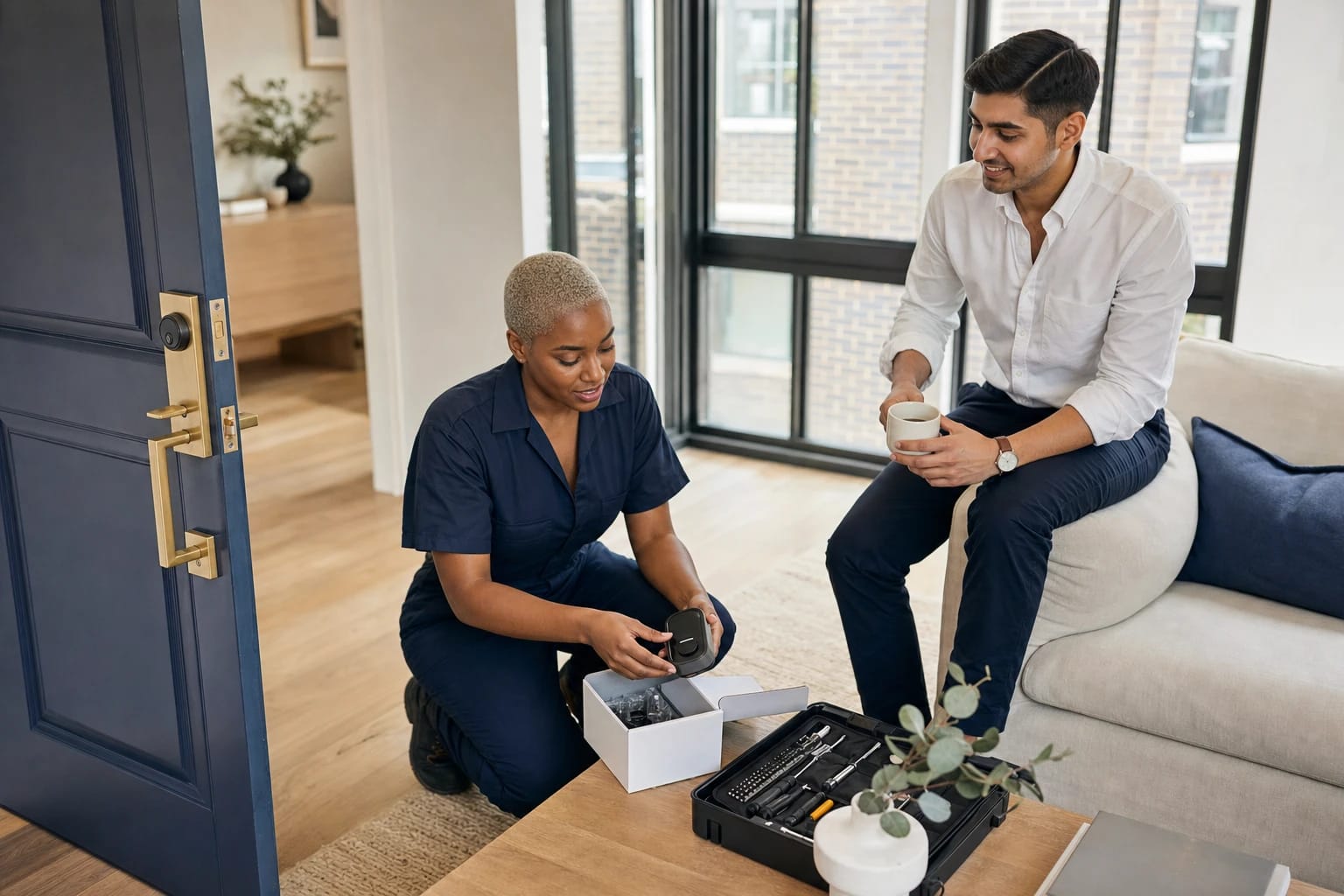
What smart lock installation covers
Fitting and setting up keypad and app-controlled smart locks on doors that are compatible with them.
- A check that the lock suits your door's thickness, backset, and existing holes
- Removal of the existing deadbolt if needed
- Installation and alignment so the bolt moves smoothly
ID and proof you may access the property are checked before any work.
Smart Lock Installation in ConnecticutSources
Public records and references this page draws on. They are outside USA Locksmith Pros and open in a new tab.
- U.S. Census Bureau ACS 2024 1-year, tables B25024 and B25034 (via Census Reporter)api.censusreporter.org (external site, opens in a new tab)
- Seaside Village Historic District (Wikipedia)en.wikipedia.org (external site, opens in a new tab)
- Connecticut General Statutes, chapter 830 (landlord and tenant)cga.ct.gov (external site, opens in a new tab)
- NOAA NCEI and NCICS, State Climate Summaries 2022: Connecticutstatesummaries.ncics.org (external site, opens in a new tab)