
Cambridge notes
Updated 4 sources
Why Cambridge locks change hands so often
Rekeying changes the pins inside a cylinder so old keys stop working while the lock stays on the door. In Cambridge the need follows the moving calendar near the campuses. The city's neighborhood planning describes Area 2/MIT as almost entirely the MIT campus, and Baldwin as taking in large parts of the Harvard and Lesley campuses. An apartment near a campus may change occupants every school year, and not every departing tenant hands back every copy of the key.
New owners face the same question at a larger scale. A house that has passed through several owners, contractors and tenants can have keys in circulation that nobody can account for.
Older doors: rekey before you replace
The 2024 Census Bureau survey counts about 30 percent of the state's homes as built in 1939 or earlier. If a pre-war door has a mortise lock, a body sunk into the door edge, a change to a modern cylindrical lock may require reworking the door. Rekeying is frequently the simpler way to cut off old keys. Gather the keys you have first, so you know which locks currently share one.
Landlords, tenants and keys
This is general information, not legal advice.
- Keys owners must provide. Under the State Sanitary Code (105 CMR 410.270), owners must give occupants keys to the main entry, their unit and the common areas. Rekeying a shared street door therefore means new keys for every household that uses it.
- Lock charges at move-in. M.G.L. c. 186, § 15B limits what a landlord may collect at or before the start of a tenancy, and the purchase and installation cost of a key and lock is one of the permitted charges.
Planning a rekey in Cambridge
List each door that should take the new key: street door, unit door, rear porch door, and any basement or laundry door. Say whether some locks should stay on their old key, and how many copies each household needs. For the service itself, see lock rekeying. A lock that is worn out rather than just exposed to old keys may call for lock replacement instead, and the Cambridge page has more on local housing.
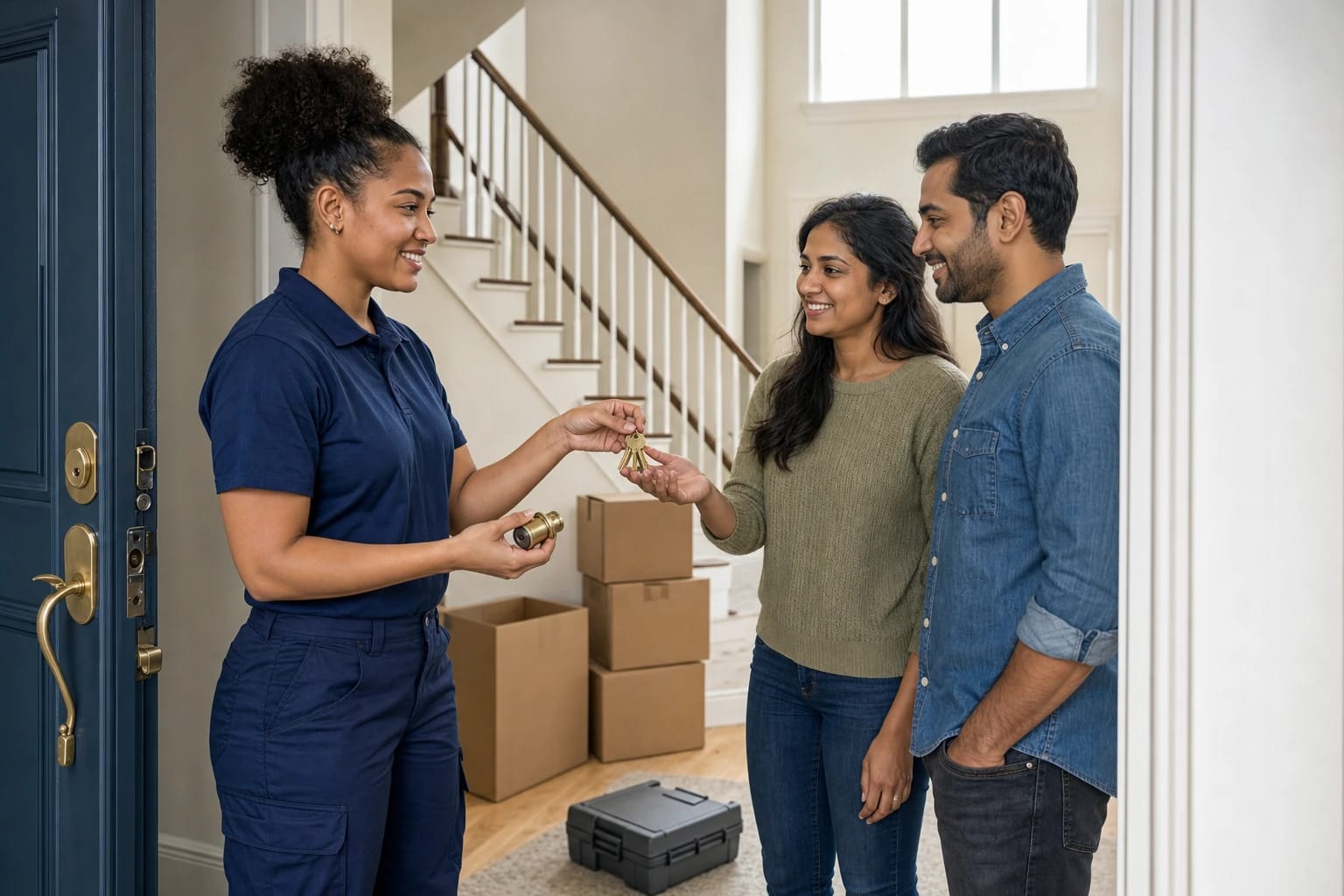
At the door
What lock rekeying covers
Changing the pins inside your existing locks so old keys stop working, without replacing the hardware.
- An inspection of each lock to confirm it can be rekeyed
- Re-pinning each cylinder to work with a new key
- New keys cut for the rekeyed locks
ID and proof you may access the property are checked before any work.
Lock Rekeying in MassachusettsSources
Public records and references this page draws on. They are outside USA Locksmith Pros and open in a new tab.
- City of Cambridge CDD, Cambridge Neighborhood Planningcambridgema.gov (external site, opens in a new tab)
- U.S. Census Bureau ACS 2024 1-year, tables B25024 and B25034 (via Census Reporter)api.censusreporter.org (external site, opens in a new tab)
- Massachusetts General Laws, chapter 186malegislature.gov (external site, opens in a new tab)
- 105 CMR 410.270, Locks (State Sanitary Code)law.cornell.edu (external site, opens in a new tab)