
Boston notes
Updated 4 sources
Why a move-out calls for a rekey
Boston neighborhoods such as Roxbury and Jamaica Plain are closely tied to the three-decker, a light wood-frame building with usually one apartment per floor. When one household leaves, its keys may open more than its own unit: the shared front door or the separate entrance for the upper floors, and often a rear porch door. A move-out rekey should include that shared entry. Rekeying resets each existing cylinder so the old keys stop working, while the lock bodies, trim and doors stay as they are.
Older doors add a wrinkle. On a pre-war door with a mortise lock, a swap to a modern cylindrical lock can mean altering the door itself, so rekeying or repairing the mortise lock is often the simpler first step.
Rules that touch keys in Boston rentals
This is general information, not legal advice.
- Keys from the owner. The State Sanitary Code, 105 CMR 410.270, requires owners to give occupants keys to the main entry, their own unit and common areas. Rekeying a shared entry means new keys for every household that uses it.
- Lock costs at move-in. Under M.G.L. c. 186, § 15B, the purchase and installation cost of a key and lock is one of the few charges a landlord may require at or before the start of a tenancy.
- Registration and inspection. Under Boston's rental ordinance, CBC 9-1.3, rental properties are registered each year by July 1, and units are inspected at least once every five years after Inspectional Services selects the property. Owner-occupied buildings with six or fewer rental units are exempt from inspection. The owner or an authorized adult attends, so after a rekey, confirm that the owner's key set still opens every unit.
Who rekeys, and when
- New owners, since sellers, contractors and past tenants may still hold keys.
- Landlords between tenancies, starting with the shared entry.
- Tenants after a lost key or a roommate's departure, once the owner agrees; the sanitary code makes entry locks the owner's responsibility.
Listing the doors
Name every door the keys open (unit, shared entry, porch, basement or storage), how many copies each household needs, and whether the locks are knobs, deadbolts or mortise locks. Add the neighborhood and cross streets. See lock rekeying, lock replacement for worn-out hardware, or the Boston page.
At the door
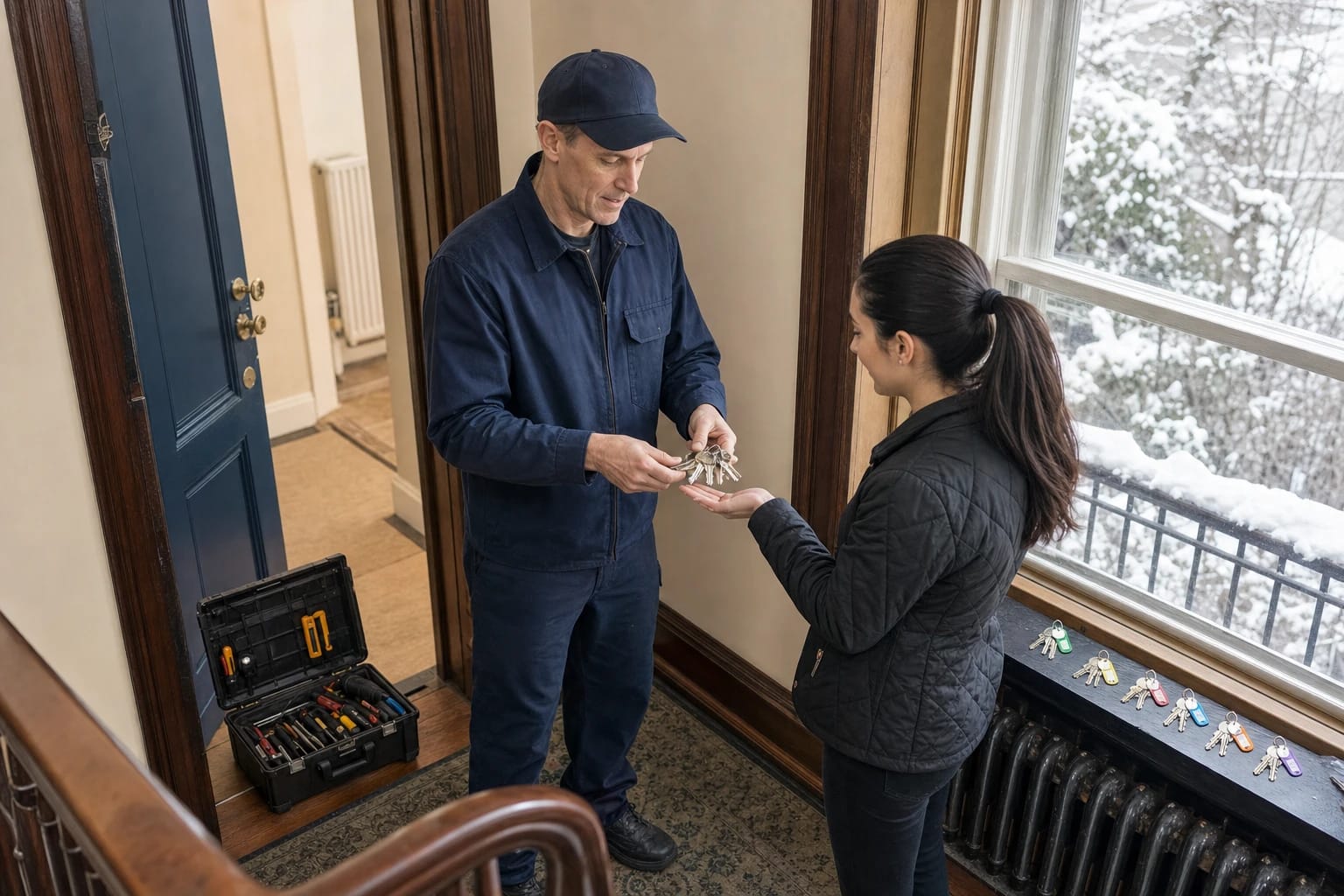
What lock rekeying covers
Changing the pins inside your existing locks so old keys stop working, without replacing the hardware.
- An inspection of each lock to confirm it can be rekeyed
- Re-pinning each cylinder to work with a new key
- New keys cut for the rekeyed locks
ID and proof you may access the property are checked before any work.
Lock Rekeying in MassachusettsSources
Public records and references this page draws on. They are outside USA Locksmith Pros and open in a new tab.
- Three-decker (Wikipedia)en.wikipedia.org (external site, opens in a new tab)
- 105 CMR 410.270, Locks (State Sanitary Code)law.cornell.edu (external site, opens in a new tab)
- Massachusetts General Laws, chapter 186malegislature.gov (external site, opens in a new tab)
- Boston Inspectional Services rental program FAQ (CBC 9-1.3)boston.gov (external site, opens in a new tab)